Time to re-read Saki's classic short story, TOBERMORY.

Friday, May 27, 2011
CATZ
A couple of recent posts from Animal Planet have got me wondering whether we're on the brink of a species breakthrough. Of sorts. First there's LOUIS v/s RICK -- The Story of The Man Who Taught His Cat To Use Instant Messaging. It's hilarious, of course. But then there's also Cooper, Ansel Adams of the Cat World. After I'd watched the Australian TV spot, and visited Cooper's web-site and watched Cooper's video (taken by himself) as he walks around, I began to feel a sense of déjà mew: the feeling that they've been acting superior all along, but we've just not had evidence before of quite how cool they really are. I mean, here's this little furry character wandering all over his neighbourhood, putting together a show of photographs and publishing a book and becoming an internet celeb -- and HE'S A CAT.


Saturday, May 14, 2011
PUNZ
Okay, time for a silliness break. I got these from a punny guy called Ranvir S!
Did you hear about the glass blower who accidentally inhaled? Now he’s got a pane in his stomach.
To write with a broken pencil is pointless.
When fish are in schools they sometimes take debate.
A thief who stole a calendar got twelve months.
When the smog lifts in Los Angeles , U.C.L.A.
The professor discovered that her theory of earthquakes was on shaky ground.
The batteries were given out free of charge.
A dentist and a manicurist married. They fought tooth and nail.
A will is a dead giveaway.
If you don't pay your exorcist you can get repossessed.
With her marriage, she got a new name and a dress.
Show me a piano falling down a mineshaft and I'll show you A-flat miner.
You are stuck with your debt if you can't budge it.
Local Area Network in Australia : The LAN down under.
A boiled egg is hard to beat.
When you've seen one shopping center you've seen a mall.
Police were called to a day care where a three-year-old was resisting a rest.
Did you hear about the fellow whose whole left side was cut off? He's all right now.
If you take a laptop computer for a run you could jog your memory.
A bicycle can't stand alone; it is two tired.
In a democracy it's your vote that counts; in feudalism, it's your Count that votes.
When a clock is hungry it goes back four seconds.
The guy who fell onto an upholstery machine was fully recovered.
He had a photographic memory which was never developed.
Those who get too big for their britches will be exposed in the end.
When she saw her first strands of gray hair, she thought she'd dye.
Acupuncture: a jab well done.
Thursday, May 12, 2011
Review of ESCAPE
This review, by RIMI B CHATTERJEE appeared in the American Book Review earlier this year. I wasn't able to link to it there but RBC has very kindly scanned the printed review, blogged it and then sent it to me. Here's a link. It's definitely the best review that ESCAPE has received so far but more than that, it's the kind of review that makes an author feel that some readers really DO make the effort to read all the way through a book. That is SO RARE ...
Sunday, April 17, 2011
Saturday, April 16, 2011
Friday, March 18, 2011
POPCORN & MOVIES
"THE POPCORN ESSAYISTS: what movies do to authors", edited by Jai Arjun Singh, will be launched at the India Habitat Centre, New Delhi on Tuesday 22nd March. All those within reach of Asia should attempt to be there. (Of course, this leaves me out, heheh).
Musharraf Ali Farooqi, Rajorshi Chakraborti, Amitava Kumar, Kamila Shamsie, Sumana Roy, Manil Suri, Madhulika Liddle, Anjum Hasan, Sidin Vadukut, Namita Gokhale, Jaishree Mishra.
It's a collection of essays by published authors who are NOT otherwise connected with films -- though, umm, some of us have had our plays made into films. Well. Whatever. My essay, JELLYFISH, is featured in the book. If you want to read the essay or -- better yet -- want to know why it's called JELLYFISH, you'll have to buy the book. Which you can do, easily enough, through FlipKart, by clicking this LINK.
Of course, there are a number of other reasons for buying the book, such as the other authors:
You can read A SNEAK PREVIEW at Jai Arjun's Blog.
And you can also read this excerpt from my essay:
[Mumbai, circa 1981. Interior]
In a room the size of a sweaty handkerchief, I and some seventy other members of the Alliance Française film club are watching François Truffaut’s The 400 Blows. The film is about to end. On screen, we see the right side of a young boy’s head and shoulders.
I wonder whether to risk a yawn.
The boy is walking towards the sea with no clear purpose in mind.
I know I am not worthy of my membership. Even though the film is one of the central pillars of modern French cinema I cannot focus on it because the auditorium is too uncomfortable. The folding metal seats have been designed by an evil orthopaedist looking for customers. The floor is uniformly flat and viewers are forced to strain their Kurosawas and Renoirs through a sieve of other viewers’ hair. In summer, the lack of air-conditioning guarantees death by B.O. And of course the majority of the movies are wrist-slittingly sad.
This one, for instance, is centred on a troubled fourteen- year-old boy living in Paris. The story moves at the pace of an arthritic sloth while packing the punch of a land- mine in the gut.
I want to inform my companion of the evening that I simply do not have the mental energy for films like this. Yes, yes, they’re beautiful, haunting, memorable, and all the rest of it, but what about the emotional wreckage they leave in their wake? I am, after all, a Hollywood junkie. I admit it without shame, like an addict who wears her needle-tracks with pride. I thrill to my Technicolor sunsets, my MetroGoldwynMayer lions and my air- brushed, peroxided heroines. Assisted Reality is what I call these films, and I love them all the more for knowing they will never kick me in the Jiminy Cricket or leave me bleeding in the Mekong.
Meanwhile my companion, whom I shall call B–, is even then, thirty years ago, so steeped in his knowledge of films and his passion for them that he seems to my eyes practically incontinent with world-weariness. We are both in our twenties, me late, he early. I enjoy his intensity and his seriousness even though I know he does not consider me girlfriend material. I often wonder what he sees in me. Nothing, probably. When a young man has watched enough art cinema, he knows that romantic love will never make it past the editing table.
Onscreen, our boy is still walking. The scenery continues to move away to the left, behind him, which is how we know he’s in motion. It’s a pleasant summer’s day and the French countryside looks suitably tranquil and inviting, even in black and white.
I begin to wonder why we’ve been watching the same damn scene for so long.
I turn towards B–.
He is sitting at the very edge of his seat, like a gundog on point.
He’s muttering to himself, ‘Come on, come on.’ That’s all he says. He’s fidgeting, he’s leaning forward with his elbows on his knees, he’s sweeping back the comma of hair that falls over his forehead and giving his fingernails a quick chew. In a word, he’s doing the adult equivalent of a child jumping up and down, screaming encouragement to Luke Skywalker taking on the Empire single-handed.
Yet before us on the screen is nothing more than a boy, walking.
[END OF EXCERPT]
Wednesday, March 16, 2011
GREAT GAME FOR CINEMA BUFFS
This is such a neat little game! It's called FAMOUS OBJECTS FROM CLASSIC MOVIES and I got it from another outstanding source-object called VSL, short for VERY SHORT LIST. If you haven't already subscribed (free, like all good things) to VSL, I suggest clicking and signing up right away. You won't regret it (though of course you might lose your day job. But then again, you won't care. You'll be too busy following up VSL's smart, interesting links).
OKAY! And here's a bonus link to BABY ELEPHANTS PLAYING IN A KIDDIE'S WADING POOL! If I were a mad scientist, I'd find a way to shrink elephants down to the size of Great Danes, so that we could all have ELEPHANTS as house companions instead of -- whatever -- dogs, cats, people. Notice, I said "house companions" rather than pets? I think we've got to stop with the "pet" concept. Or anyway, not when we're talking about animals other than humans.
Saturday, March 05, 2011
Review of ANAND GIRIDHARADAS's INDIA CALLING in OUTLOOK
But first, an amusement of the Rock-Paper-Scissors kind: play against a computer at the New York Times: MATCH WITZ WITH A ROBOT HAND!
The thing that wasn’t clear to me by book’s end was whether the author set out to tell us more, then decided to hold back. He weaves the personal narrative of his parents’ departure from India, his own upbringing and the stages by which he revisits India as an adult in between the stories he gathers from a handful of others. The result is patchy, as if he has selected from a rather slender stock of options. Of his own story, the most intimate glimpse he offers is of the account left by his paternal grandmother, a 32-page document entitled ‘Our Marriage’. Though the author tells us that “it conjured a world that was unrecognisable in twenty-first-century India,” I would say the exact opposite. Not only has very little changed in the way marriages are arranged but in his descriptions of personal life, Giridharadas is just as reserved a writer as his grandmother was. He refers to his parents’ love-match and to his own shadowy girlfriends in the manner of a chef who mentions chillies but doesn’t use them.
And here's the review. It appeared on Saturday 5th March, in OUTLOOK Magazine (I didn't choose the title!):
KNOW INDIA--Learn the Alphabet By Heart
Barely have we strapped ourselves in to read Anand Giridharadas’s rollercoaster ride of thoughts, experiences and interviews about being an Indo-American who returns to India, when whoosh! It’s over.
But in its brisk way, the book covers a broad area while sparing us the mandatory visits to slums, brothels and palaces. It should appeal to the thousands of so-called ABCDs—American Born Confused Desis—who struggle with feelings shading from guilt and confusion to joyous surrender to their ethnic homeland. Amongst the most corrosive results of emigration is the loss of a past without the benefit of gaining a present. For the Indian diaspora, the typical cultural dislocation of all immigrants is multiplied many times over by the fact that, as a culture, we’re not homogeneous and the shared citizenship is an illusion. We might find ourselves being thrown together with others of our nationality only to realise that we have neither food, language, religion nor social experience in common. We would be better off with complete aliens, who would at least have no expectations, than with one of our “own”, who might be inclined to penalise us for being non-standard.
Giridharadas’s story is just one amongst the countless multi-dimensional histories that this diaspora has begun to write. His parents left during the peak “brain-drain” years. They fell in love in India and married across the Punjab-Tamil Nadu cultural divide. Once in the US, they assimilated quickly, raising their two children as Americans, rather than as Indians-in-Exile. In this way, Giridharadas had less confusion to contend with than many others. His face and genes are Indian, but the organisation of his thoughts is American. When he talks to Ravindra the Roller Skating King or the hapless divorcing couples at the Bandra Family Court or the god-emperor-industrialist Mukesh Ambani, it is as an outsider looking in, but with the advantage of looking like an insider.
|
Trained as a management consultant, the author moved to Bombay in 2003, working for McKinsey & Company for two years. Having previously interned with the New York Times at the age of 17, he returned to journalism in 2005, reporting from Bombay for the NYT andHerald Tribune for four years. The stories he tells best are those which work as set pieces in a column, such as the scenes at the Family Court and the tragicomic account of his stay in a Ludhiana home belonging to two brothers, where climbing the stairs from the ground to the first floor is like time-travel from the fly-blown hospitality of the past to the cell-phone-enabled future. I wondered how his subjects would respond to their depiction in this book, whether they felt violated rather than showcased. But perhaps that’s always the case with documentary footage?
I also found myself being reminded, oddly enough, of both Geeta Mehta’s Karma Cola (1979) and Suketu Mehta’s Maximum City (2004). Both were huge best-sellers, but one was written as infotainment and the other as dispatches from an urban war-zone. Giridharadas is cooler, younger and more detached than either of these writers. He writes with the confidence of the marathon runner, who knows he has many miles to cover before he truly finds his way home.
Friday, March 04, 2011
AMAZEMENTS of the VISUAL KIND
Serious brain candy! Click this link: BEST PHOTOMANIPULATION ARTISTS
I came across it at the BEST BOOKMARKS site. Here's what they say about themselves:
Best Bookmarks is a daily-updated, lifestyle blog for everyone who loves Arts in general, Paintings, Illustrations, Sculpture, Photography and more.
We keep track of everything interesting so you don’t have to.
Each post brings you to a place worth visiting.
Best Bookmarks is the right place for you! We are sure you will find something that piques your interest.
Enjoy Best Bookmarks.
All works (images, portfolios) are property of their authors. Any usage is forbidden. All files available at this website (BestBookmarks.net) are provided for educational purpose only. Users are responsible for further use of the files they have downloaded.
Monday, February 28, 2011
PLAYTHING!!
There are some things that leave you with no option but to drop whatever else you're doing and PLAY. Here is one of those things: Mitoza. It's not quite a game or a puzzle and it's certainly more than a slide-show. Designed by an Israeli artist who goes by that handle "Baboon" it's one of those things that gives the Internet a good name.
UPDATE: Sadly, this site posted an ACCOUNT SUSPENDED sign some time later today. I'm hoping it's just because of heavy traffic or some such thing and that it'll be back up SOON.
Further UPDATE: And while you wait, here's a site I found interesting: THE WEEK BEHIND -- you'll see that they've featured MITOZA too -- and a little further down there was this rather beautiful and hallucinatory KALEIDOSCOPE.
And ... just to show all of you that I am reallyreallyreally concerned about the quality of your visit, I discovered a site where Mitoza is featured and it DOES work: KONGREGATE.
Sunday, February 20, 2011
Short Pieces
These two pieces appeared recently -- the first one on the edit page of the Times of India (in what's called the Third Edit slot) and the second one in OUTLOOK magazine, as part of its Cricket Special issue. The Third Edit pieces are going to be semi-regular, appearing once-in-three-weeks, on Mondays. The titles are links to the online editions of the pieces.
The Times of India, February 13th 2011
Familiar mnemonic sequences sometimes need updates. For instance, I can remember learning Every Good Boy Deserves Fudge when I was twelve. The initial letters of the words, E,G,B,D,F represent the names of notes on the five lines of the treble clef staff in western musical notation. Alas, however, I got it into my head that Every Good Boy Deserves APPLES, rather than Fudge. Worse yet, since I wasn't a boy, I tried to provide Every Girl (with) Big Delicious Apples. The resulting confusion effectively brought my musical career to a quick and screechy end.
But mnemonic devices have never ceased to fascinate me. Even as I grow more absent-minded with each birthday, my yearning to know the names of the nine Muses or the progression of taxonomic categories in biology becomes ever more intense. Particularly in the middle of the night. There is nothing so dismal as to lie awake at three a.m., with the planets from Mercury to Jupiter spinning around the sun in an orderly fashion, but Pluto, Uranus, Neptune and Saturn milling about in disarray at the outer fringes of the solar system. It doesn't help that their initial letters form the handy, but incorrect, acronym PUNS or that Pluto was de-classified as a planet in 2006. The familiar mnemonic, My Very Energetic Mother Just Served Us Nine Pizzas has had to be altered and the new suggestions are all a bit disturbing. They range from My Very Eccentric Mother Just Served Us Nothing to My Very Evil Mailman Just Showed Up Nude. At three a.m., the last thing you want is to be fretting about pizza-free mothers and evil, naked mailmen.
I used to think VIBGYOR was the accepted mnemonic for the colours of the rainbow. Despite the fact that the colours are reversed and the word is an ungainly earful, I honestly believed this was how the English-speaking world remembered the sequence Violet, Indigo, Blue, Green, Yellow, Orange and Red. So it's a rude shock to discover, via Wikipedia, that it's been Roy G. Biv all along! Not only that but in the UK, the preferred formula is Richard Of York Gave Battle In Vain. This is hardly useful to those of us who might turn into dangerous colour-blind insomniacs, as we churn about in bed, reciting Richard Of Gere Battling Various Irksome Yokels instead.
Sometimes, the only solution is to find one's own mnemonic. For instance, I have secured the Muses in memory by placing their names in alphabetic sequence. This yields Calliope, Clio, Erato, Euterpe, Melpomene, Polymnia, Terpsichore, Thalia and Urania – a very easy-to-recall sequence of CC-EE-MP-TT-U. Needless to say, it works particularly well for me because my initials are MP. Taxonomic categories? Not a problem: Dear Kilroy, Please Come Over For Gay Sex stands for Domain, Kingdom, Phylum, Class, Order, Family, Genus and Species. So I was doing okay with the late-night frets until I came across this one: Camels Often Sit Down Carefully. Perhaps Their Joints Creak? Possibly Early Oiling Might Prevent Permanent Rheumatism. It's for the Earth's geological periods: Cambrian, Ordovician, Silurian, Devonian, Carboniferous and so forth. But its imagery is much too complicated. I get to the Permian, Triassic, Jurassic and Cretaceous without mishap. Then the Paleocene begins and I'm lost in a hopeless tangle of Oily Masseurs and Rheumatoid Perverts.
So when I found a small book called THE ORDER OF THINGS by Barbara Ann Kipfer, I thought I was saved. I kept it by my bedside and slept peacefully for several weeks. Until the night when I happened to glance elsewhere in the book and noticed something terrible: the graphic for silverware shows a cheese knife in place of the fish! My confidence in the book is shattered. Herds of arthritic camels hobble enthusiastically across my pillows once more and the Duke of York eats pizzas every hour. And no, that's not a mnemonic for anything.
OUTLOOK Magazine, February 21st, 2011
When OUTLOOK invited me to write an essay for their Cricket Special, I said, 'Sorry! Don't know a thing about the game. It's like I'm colour-blind, you know? But for cricket.'
'Whoa,' said the man from OUTLOOK. 'You must be a total social pariah, right? So tell us what that's like! Amazing. Seven-fifty words by next week?'
'Wait, but—' I spluttered. Too late. He'd put the phone down.
It's not just cricket: it's sports in general. I get no thrills watching teams of Neanderthals kicking an inflated bladder of polyurethane between goal-posts or muscle-bound viragos in short skirts slamming fluorescent green missiles across a red clay court. In the case of cricket it's one team whacking a shiny red sphere so that the other members of the team can … ummm … well! There we go. I can't even understand the objective of the game. Fellows in white run about. The crowd roars. The score changes. And then one of the fellows in white is once again rubbing the hard red sphere against the sides of his pants in that ominous way, like a bull pawing the ground just before charging.
My explanation for the excitement that surrounds these activities is the R-word: Religion. Yes, it's one of my themes of late. Public art installations, sports, romance – all, in my view, are expressions of religious fervour. Belief in a Higher Power provides an anchor in the Ocean of Doubt. However many children die in your arms, spouses divorce you, lovers betray you, dictators rise and fall, stock markets crash or recover, there is some corner of a playing field that is forever glorious. With victory. With defeat. With valour. With sweat. With passion.
Anything that mimics religion gains by association. You know how the concept of One True Love has been promoted relentlessly as the international gold standard of Romance? Well, I believe it's a cunning extension of monotheism's ever popular One True God concept. Celebrities who stray from monogamous ideals are burnt at the stake of public disapproval while those who remain faithful to one partner all their lives are showered with tributes and giant fan-followings.
Extend this idea to sports and you get a million fans chanting "Sa-CHIN! Sa-CHIN! Sa-CHIN!" and painting their faces with the tri-colour in a close approximation of devotees chanting the Divine Name in a temple and ascetics at the Kumbhamela painting their faces with saffron and white ash. At one time, an interest in sports was considered a distinctly masculine preoccupation, connected to physical prowess and the warrior's ethic. But that's changing, isn't it? Sports has become a subset of religion and religion merged with patriotism long ago. So women, traditionally responsible for maintaining the spiritual core of the home, are bound to make space for these new gods on the altars of their private prayers rooms.
Where does that leave unbelievers like me? Just as you might expect, in a grey and silent space. There are neither the dizzy heights of victory to soar up towards nor the bottomless depths of loss to be shattered by. It's not that I haven't felt the occasional tug of faith. I can remember a night-spend at a friend's house once, years ago, to watch a match on her superior television set. As a teenager I was dragged to a couple of games at Bombay's Brabourne Stadium. And as a child when my father was Ambassador to Thailand the Nawab of Pataudi stayed in our house. The other kids at the Embassy were incandescent with envy, but I'd grown up away from the Motherland. I'd never heard of the famous cricketer and therefore had no idea how lucky I was.
Initiation to any religious faith needs to occur early in a person's life and it's obvious to me now, at 57, that I missed out. I cannot possibly memorize all the crazy terms for instance. What's a mid-off and who says it's silly? Why are there legs before wickets, not whole bodies? Where are the maidens and what are they standing over? As for the ducks, don't they get hit by all those sizzling balls? And who removes the poor things when they die? Is it the night-watchman?
There's just too much to learn and never enough time! In the dibbly-bobbly corridors of uncertainty, with no friendly white-clad gardeners to worship and no bails to lose, unbelievers like me were clean-bowled by destiny a long time ago.
Sunday, February 13, 2011
My Dad's Birth Centenary


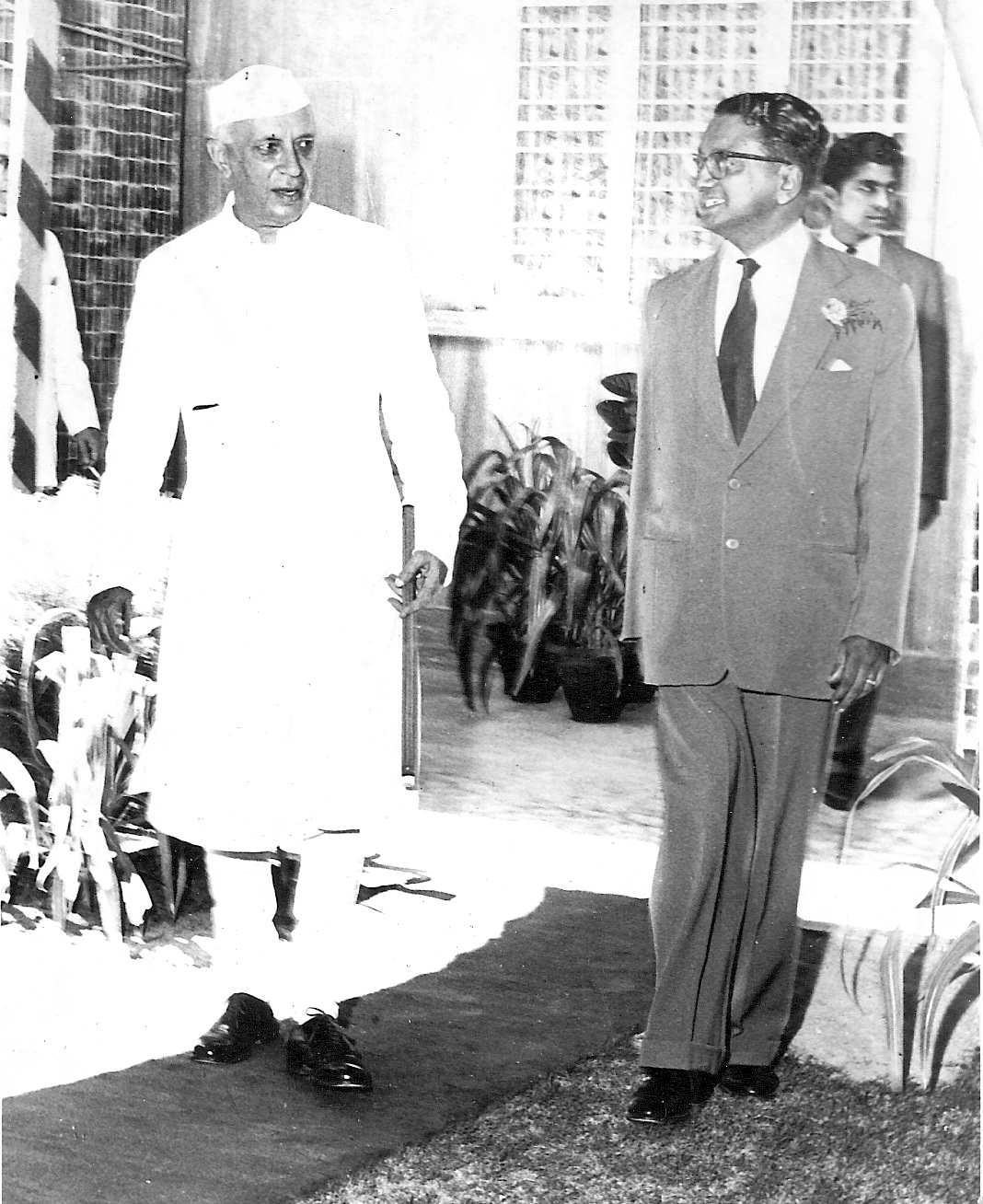
 February 13, 1911 -- February 13, 2011: as this is a special birth date for my father, K. V. Padmanabhan, I thought I'd post a few photographs. We're all sensitive these days about what part of the shared record is made available on-line, so I've confined myself to just these four. The first is of my Dad and me as a baby, most likely taken in Bangalore just before we left for Sweden in 1953-4 (not sure of dates! Will amend when I've checked); the next is of both my parents and me, in Thailand, circa 1965, when I was 12; the next is of Dad with the man he called with great affection and warm reverence, "Panditji" -- I'm guessing it was taken while we were in Karachi, circa 1959-60; the last is of Dad with (not sure what kinds of titles are appropriate so I'm not attempting the name) the King of Thailand, most likely in the first year we were there, 1964.
There's a great deal I could say about Dad's illustrious career, his journey from tiny, French-speaking Mahé in Kerala to representing India as Ambassador to Thailand and Iran. But all that matters is that he was a wonderful Dad. He was good, kind and scrupulously honest, with a strong sense of humour. He collected comic strips and stamps in his youth and always enjoyed doing puzzles. I can remember, for instance, him glueing together a crystal vase that had shattered in transit -- it would never look all right, but he did it for the pleasure of the challenge.
Friday, February 04, 2011
MANIPUR SONG


(2008, English, with subtitles)
Distributed by Magic Lantern Foundation.
------------------------------------------------------
If a scream could be recorded, then filmed, then edited so that only the shadow of the pain revealed by that terrible sound might be heard, the result might look a bit like Pankaj Butalia's MANIPUR SONG.
At the time that I began watching the film (at home, on DVD), the amount of practical information I had about the "small northeastern state" of Manipur wouldn't fill one of the dimples on the outer surface of a thimble. I use those quotation marks because it's the kind of description that is routinely used of a "small northeastern state" and it is, whether we want to think of it that way or not, just one of many ways that we discriminate against places that are physically small. And "marginal". After all, however small Manipur may be, if it were located somewhere close to Connaught Place in New Delhi, we would never refer to it in that way.
The movie is not intended to be an educational supplement for people like myself who have not managed, for whatever reasons, to be better informed about their own country. What it does is remind viewers like me that we live in a vacuum of awareness. A reminder that "news" is only the items that get past all the filters that exist between news-consumers and the continuous bleeding of reality from all the pores, gaping wounds and sores and orifices that make up the world we live in.
Through five or six shifts in perspective, scenes from another world appear. Initially, it is a fairly familiar world – it could be anywhere in those "marginal" places, far from the cities – there are ill-made roads, slender young men in uniforms, their faces smoother and more hairless than their counterparts on the plains, their eyes shaped differently into those elongated shapes that we, of the plains, find various derogatory ways of describing: slit eyes, chinky eyes, slanty eyes – and yet, as the film gradually unfolds, I realize it's not familiar at all. Not to me, anyway.
The scenes that stand out for me include:
*The interviews with the young woman dissident called Sharmila – Wikipedia tells me that her full name is Irom Chanu Sharmila – who is even now living in the limbo of detention, a feeding tube threaded through her nose to prevent her from dying of her hunger. She has been on hunger strike since 2000. She was 28 at the time she began and has not let up since then.
*The "naked protest" of Manipuri women, at the gates of the Assam Rifles headquarters.
*The groups of young men, apparently being urged by soldiers to cane one another – all of them looking so similar to one another (I mean, racially similar) except that the soldiers were taller and better-fed, and the actions carried out with so little apparent passion, that it would have been farcical if it were not so pitiful. Toy soldiers, toy dissidents, but the blood, the pain, and the deaths only too real.
*The women drug addicts injecting themselves with the clear liquid that rules their lives so thoroughly, yet so invisibly too. This footage was, I thought, extraordinary exactly because it was presented with no squalor, no drama, no special lighting, no salacious, invasive, prurient commentary. It was the extreme domesticity of these scenes that gave them depth. We might have been watching a wild-life film in which a syringe is readied for use on a wild animal, to subdue it. And as that thought appears in my head, I realize that it IS what's happening and that these young women, from their quiet lives in distant villages, ARE being anesthetized, subdued and put to sleep, by forces out of their control.
*The school girls at the end, the sweet simplicity of their nursery rhymes and their soft, defenseless faces contrasted against the implacably jagged background of the whole rest of the film.
I realize, seeing this film, that all unknowingly, I've been aware of Irom Chanu Sharmila – because over the course of several years, I've noticed the face of a woman, stenciled in blue, that has appeared here and there on walls around the city. It is a small stencil, but draws attention to itself easily – perhaps because the face, with its pouting mouth and its narrowed eyes, the brows slanted in a permanent frown appears not angry so much as fierce – perhaps because it is positioned on white walls and looks freshly painted. All the time.
There is so much more that might be said, but – just as in the film, with its curious restraint, its silences despite the song referred to in its name – to use violent language, to scream, to lash out, or in any way to lose composure would be besides the point. What we see has little to do with having reactions or registering emotions. The film is that smallest and saddest of things: a tiny but dignified, well-made and carefully crafted gravestone for a culture, a people, a protest, and a movement. A gravestone made even while the culture, the people, the protest and the movement are still alive and still breathing.
[Manipur Song is distributed by Magic Lantern Foundation]
Friday, January 28, 2011
Wednesday, January 26, 2011
Opinion Piece in OUTLOOK
ART WITHOUT HEART appeared in this week's OUTLOOK Magazine. It's my response to the Anish Kapoor show that's on in Delhi at the moment. I know lots of people who adore his work and I did too -- well, not "adore", but I liked it, sort of. It caused an interesting tickle in the brain. Now I only want to run the other way. There's a photograph of the model for the piece called "ORBIT", being readied for the London Olympics next year, accompanying the article.
Monday, January 24, 2011
A Beautiful Story
This appeared in the New York Times (possibly today, in the section called "Region"): Against All Odds, A Beautiful Life. Keep a handful of tears on stand-by. It was the horse that tipped the balance for me ...
Monday, January 17, 2011
DISTRICT 9
It should've been called "District Nein! Nein!", in my opinion. My critique of it appeared in the TOI this morning under the title: A CAUTIONARY TALE.
Sunday, January 16, 2011
EMOTIONAL INTELLIGENCE
For some people THIS LINK might be the most important thing they read this year. From The New Yorker. About findings from the forward reaches of modern-day social science.
Sunday, January 09, 2011
VIRTUAL LOVE = VEROS INFECTION?
I've been visiting Salon.com's advice-chat column "SINCE YOU ASKED", written/managed by Cary Tennis, for a couple of weeks now. Today's offering has something of special interest to subcontinentals: I'm From India, Crazy In Love.
Worth a visit, mainly to witness the extraordinary levels of cultural missed catches.
Worth a visit, mainly to witness the extraordinary levels of cultural missed catches.
Sunday, January 02, 2011
LUFTHANSA's VIRTUAL PILOT GAME
This was sent to me by my Itallian Connection, PL!!! A game that leaves me feeling at the mental level of a cicada -- obviously something I adore, coz I play it at least a half-a-dozen times in a row, getting worse and worse scores each time. Time to pass it on to all you Geography buffs: LUFTHANSA TO EUROPE. This is perhaps the only way left to enjoy air travel these days!
Subscribe to:
Posts (Atom)