What a major thrill -- I have finally discovered how to generate symbols without going into the Special Characters menu -- and I wasn't even looking! Obviously, many of those I "discovered" won't translate equally well on all the potential monitors that might display this blogpost, so I'm not going to make a big effort to show off this discovery, but -- for instance -- I can finally write 'cliché' correctly, online (I could always do it in Word dox, but could not reproduce that effect online). Nice, huh. And 'Æsop's fables'. It's a simple trick and different keyboards no doubt have different combinations that help achieve it but on the MacBook Pro it involves the OPTIONS key, various combinations of. I didn't get it right away because on earlier machines, to get an accent into place, I had to highlight the letter then type the required accent. With the Options key, it's a bit in reverse -- for the é for instance, it's Option+e, then e again. ƒåßçîñæ†ìñ©… (translation: fascinating ...)
The 'and I wasn't even looking' is my lead-in to another recent MAJOR THRILL -- watching the Beatles movie 'HELP' the other day, on DVD. I always loved this film -- I saw it on the big screen, in Bombay (at EROS Cinema, Churchgate), maybe a year after it came out, and if I could have, would have seen it many times over to memorize key scenes -- but of course that wasn't really an option in those days, as I was still in (boarding) school and wasn't at liberty to just dash off to see any movie I liked.
It's been digitally remastered and is absolutely sumptuous. I didn't realize at the time I ordered the DVD that iTunes was going to be show-casing the Fab Four starting today (or was it Yesterday?), not that it would make a difference -- but I may have felt I was band-wagoning if I'd known. Which I wasn't.
Watching it again reminded me that it was still very funny in a way that anticipates Monty Python's Flying Circus by about five years (I had to check to see the dates -- 1965 for HELP, '69 to '70 for MPFC) -- it's something I didn't recognize at the time I saw MPFC, though I knew they were channeling the Goon Show -- but also just their own I-Am-The-Walrus wackiness. They anticipate political correctness to an astonishing degree, considering that it was NOT the order of the day: they use a multi-armed deity they name 'Kaili', importune a goddess they call 'Perverti' and though characters are obviously dressed to simulate SubContinentals, they're just enough off the mark (I suppose ...) to get away with their spoof. They're quite vicious towards the British characters in the film -- the manic scientist who complains bitterly about the lack of Govt recognition and the daft elderly-lady neighbours, f'rinstance. The mumbling conversations of the 'Head Priest' in which he complains about young people not being attracted to human sacrifice any more, 'such a shame!' and wonders what can be done to make it more palatable. LOVE it.
Like I LOVE the tiger, the idiotic winking lady, the Beatle-fan who was the original sacrificial victim, the crazy 60s clothes ... and of course, of course, the boyz themselves, singing.
For me the best bit is the way Ringo finally gets the ring off his finger --SPOILER ALERT-- not all thru the main part of the film, when he desperately wants to, but only at that moment when he's distracted from the need to get it off his finger and is no longer obsessing over either keeping it or removing it and because at that moment he genuinely wants to help the petitioner. I always thought (but yes, of course I romanticize the Beatles out of all proportion) this was totally THE HEIGHT of transcendental philosophy revealed in the banal-pop medium of a Beatles film. Way out.
To top this, I have also ordered the DVD of Magical Mystery Tour, which I've never seen. Yes, yes, I know it was such a low-tide moment in cinema that even die-hard Beatle fans are embarrassed by the film. That's why I want to see it. I want to Love The Hate. Haven't got it yet! Will report when I do.

Wednesday, November 17, 2010


Saturday, November 06, 2010
Wednesday, October 27, 2010
NATURAL REMEDY FOR DENGUE?
UPDATE: A friend posted a link suggesting that this so-called cure is most likely a hoax. Please follow this LINK. It's the same as the one in the second comment to this post. I'm removing most of the original post regarding the "cure" but if you'd like to know what it was anyway, then follow the link in the paragraph below this one.
A friend sent this to me. I do not have first-hand information but since the method appears to be otherwise harmless AND easy to resort to, I think it's well worth the try. Here it is: (disclaimer: I don't know, in both accounts given below, who the "I" is. The message is as it came to me, with no changes made to it by me. I Googled Won Low Kat and found several sites listing the same advise about the papaya leaf cure. I have NO idea what "Won Low Kat" is! The story and information appear to be sourced from the Philippines or Indonesia. There are very many links to blogs featuring the same or very similar text, but this one includes a photograph of the papaya's leaf: A SAILOR'S MUSINGS.
A friend sent this to me. I do not have first-hand information but since the method appears to be otherwise harmless AND easy to resort to, I think it's well worth the try. Here it is: (disclaimer: I don't know, in both accounts given below, who the "I" is. The message is as it came to me, with no changes made to it by me. I Googled Won Low Kat and found several sites listing the same advise about the papaya leaf cure. I have NO idea what "Won Low Kat" is! The story and information appear to be sourced from the Philippines or Indonesia. There are very many links to blogs featuring the same or very similar text, but this one includes a photograph of the papaya's leaf: A SAILOR'S MUSINGS.
Saturday, October 23, 2010
OUTLOOK MAGAZINE's 15th Anniversary Issue

Here's a LINK to my essay in the issue -- it features a couple of old SUKI cartoons! Here's one of them -- a fragment from the "Historionics" episode published in THIS IS SUKI.
Saturday, October 16, 2010
THE BOY IN THE STRIPED PYJAMAS and other movies
Last night I watched an excellent movie I had vaguely heard of but not seen: THE BOY IN THE STRIPED PYJAMAS. A simple story (referred to as a "fable" at one website) by Irish author John Boyne, it worked entirely because of the believable performances, especially by Asa Butterfield as Bruno the eight-year old son of an SS Officer whose father is stationed just outside Auschwitz. Bruno befriends a boy of his age on the other side of the electrified wire fence and … well, it's a story and not an especially credible one. Extremely moving all the same.
Was I just in the right mood to see it? The Wikipedia article about the book on the which the film was based suggested that both the novel and the film came in for sharp criticism -- the unlikelihood of such a situation developing was the main charge I think, but there were stronger views -- but I wasn't greatly bothered by the knowledge that it was "just fiction" after all. I think a story like that -- and the film in particular -- maybe works better as fiction. It opens up a pathway that cannot be refuted by mere facts about what might have been -- and then takes the viewer down a corridor that is strangely sweet even while horribly sad.
If you'd rather not know what happens, please don't read this paragraph. For me, the ending suggests that even while one part of Germany saved itself by using elaborate arguments to justify atrocities against the Jews, the other part, the soul perhaps, disappeared as surely and irretrievably as Bruno into the ovens. This movie presents that soul and its disappearance in heart-rending form, in the person of the little boy. Every time I tell myself that I cannot bear to watch yet another film about WWII, I see a fresh reminder that there's a good reason to remember and be re-inoculated against that particular form of brutishness -- because the story never really stops, it only translates itself into dozens of different new versions.
It's been a good fortnight for movies: perhaps two weeks ago I saw PEEPLI LIVE (Hindi, 2010 dir by Anusha Rizvi, Mahmood Farooqi), followed by WELL DONE ABBA (Hindi, 2009, dir Shyam Benegal) and VAANAPRASTHAM (Malayalam, 1999, dir Shaji N. Karun), all on DVD. I liked the first best, the second one least and the last one … well, I enjoyed it in a purely visual sense, because it concerned the life and times of a Kathakali dancer.
PEEPLI was clever, well-acted, excellently well-cut and had a great script but I would have preferred a different ending. It was so obvious that (a) someone would die and (b) that it would not* be Natha, the poor farmer whose would-be-suicide the film revolves around, the only element of surprise that remained was to discover how the situation will be resolved. So when it is resolved in the canonical way -- see the film and find out -- I was disappointed. It seemed to me that an opportunity to discover a less oh-well-yes-it's-got-to-end-SOMEHOW ending was missed. But this is a minor quibble, considering the smart and keenly-observed quality of the film. It's got the quick wits of a television commercial but the heart of a documentary. *(his death would be too, too obvious for such a cool film)
ABBA was (for me) unbearably, unforgivably paste-board cute. I am the wrong audience for films of this sort, where everything has to be make-believe, from the Mr Nice-Guy driver with the saintly-but-irritable-executive-boss, to the cheeky-beauty-smartypants daughter, to the long-suffering-police-officer … you get the picture: one endless album of stereotypes. I detest this kind of cinema because I feel it talks down to everybody and the sarcasm -- oh! A well that was paid for by a Govt scheme never materializes and eventually is reported to the police as having been "stolen" -- is meaningless in a country where it is no longer even ho-hum news to hear of taxes being paid for houses that have never been built and defaulting tax-payers receiving threatening notices for years after their deaths. But it worked for my co-watchers at home, all of whom are fond of sophisticated cinema but who found it charmingly rustic and were willing to award it the Social-Relevance-Against-Impossible-Odds Prize.
VANAPRASTHAM came highly recommended and so for me was a much greater disappointment than if I'd realized that it was an annoying and weepy story dressed up as a stirring art film built around the spectacular costumes of a Kathakali performance. I don't get any thrills from hearing Malayalam since I can't understand anything said onscreen and though I LOVED the costumes, the story was moronic. Or it WOULD have been moronic if it hadn't been performed in Art Motion (that's slow motion for the sake of Art, not Sports) and been Heavy With Cultural Significance. Even with the subtitles, which were ungrammatical, too literal and yet also obscure in meaning, the story was hard to follow. The characters seemed to age at differing speeds -- a little girl of perhaps five grows into a lissom young miss of at least 16 during the same time frame as a baby who grows into a maybe five year old boy (going only by their appearances -- I couldn't read dates or follow the time references). Meanwhile the parents, estranged by social class and personal quirks barely show the passage of time at all.
It's like watching a gift parcel being tossed in one's direction from a distance, watching it arc through the sky, imagining/hoping that it might be aimed in one's direction and then watching it fall quite far afield: it was never intended for this viewer after all, is what one realizes. And those for whom it is made, apparently live in a dimension of extreme, brooding emotions that can never be released through logic or calm reflection, passions that can never to be talked through or smoothed out: all of existence viewed as one continuous storm of untamable Feeling. Ooh! AAAhh! SobSobSob. Exhausting and unsatisfying, however beautiful the costumes.
But it won international awards and brought its star actor, Mohanlal much fame.
Nevertheless there were a couple of moments I DID appreciate. One was when the dancer (Mohanlal) visits his lady love -- a very refined and intellectual woman -- in full costume. We never see them entwined in any way, but when he leaves her, their intimacy is revealed by the rich colours that have rubbed off on her face! Delicious.
Was I just in the right mood to see it? The Wikipedia article about the book on the which the film was based suggested that both the novel and the film came in for sharp criticism -- the unlikelihood of such a situation developing was the main charge I think, but there were stronger views -- but I wasn't greatly bothered by the knowledge that it was "just fiction" after all. I think a story like that -- and the film in particular -- maybe works better as fiction. It opens up a pathway that cannot be refuted by mere facts about what might have been -- and then takes the viewer down a corridor that is strangely sweet even while horribly sad.
It's been a good fortnight for movies: perhaps two weeks ago I saw PEEPLI LIVE (Hindi, 2010 dir by Anusha Rizvi, Mahmood Farooqi), followed by WELL DONE ABBA (Hindi, 2009, dir Shyam Benegal) and VAANAPRASTHAM (Malayalam, 1999, dir Shaji N. Karun), all on DVD. I liked the first best, the second one least and the last one … well, I enjoyed it in a purely visual sense, because it concerned the life and times of a Kathakali dancer.
PEEPLI was clever, well-acted, excellently well-cut and had a great script but I would have preferred a different ending. It was so obvious that (a) someone would die and (b) that it would not* be Natha, the poor farmer whose would-be-suicide the film revolves around, the only element of surprise that remained was to discover how the situation will be resolved. So when it is resolved in the canonical way -- see the film and find out -- I was disappointed. It seemed to me that an opportunity to discover a less oh-well-yes-it's-got-to-end-SOMEHOW ending was missed. But this is a minor quibble, considering the smart and keenly-observed quality of the film. It's got the quick wits of a television commercial but the heart of a documentary. *(his death would be too, too obvious for such a cool film)
ABBA was (for me) unbearably, unforgivably paste-board cute. I am the wrong audience for films of this sort, where everything has to be make-believe, from the Mr Nice-Guy driver with the saintly-but-irritable-executive-boss, to the cheeky-beauty-smartypants daughter, to the long-suffering-police-officer … you get the picture: one endless album of stereotypes. I detest this kind of cinema because I feel it talks down to everybody and the sarcasm -- oh! A well that was paid for by a Govt scheme never materializes and eventually is reported to the police as having been "stolen" -- is meaningless in a country where it is no longer even ho-hum news to hear of taxes being paid for houses that have never been built and defaulting tax-payers receiving threatening notices for years after their deaths. But it worked for my co-watchers at home, all of whom are fond of sophisticated cinema but who found it charmingly rustic and were willing to award it the Social-Relevance-Against-Impossible-Odds Prize.
VANAPRASTHAM came highly recommended and so for me was a much greater disappointment than if I'd realized that it was an annoying and weepy story dressed up as a stirring art film built around the spectacular costumes of a Kathakali performance. I don't get any thrills from hearing Malayalam since I can't understand anything said onscreen and though I LOVED the costumes, the story was moronic. Or it WOULD have been moronic if it hadn't been performed in Art Motion (that's slow motion for the sake of Art, not Sports) and been Heavy With Cultural Significance. Even with the subtitles, which were ungrammatical, too literal and yet also obscure in meaning, the story was hard to follow. The characters seemed to age at differing speeds -- a little girl of perhaps five grows into a lissom young miss of at least 16 during the same time frame as a baby who grows into a maybe five year old boy (going only by their appearances -- I couldn't read dates or follow the time references). Meanwhile the parents, estranged by social class and personal quirks barely show the passage of time at all.
It's like watching a gift parcel being tossed in one's direction from a distance, watching it arc through the sky, imagining/hoping that it might be aimed in one's direction and then watching it fall quite far afield: it was never intended for this viewer after all, is what one realizes. And those for whom it is made, apparently live in a dimension of extreme, brooding emotions that can never be released through logic or calm reflection, passions that can never to be talked through or smoothed out: all of existence viewed as one continuous storm of untamable Feeling. Ooh! AAAhh! SobSobSob. Exhausting and unsatisfying, however beautiful the costumes.
Monday, October 11, 2010
Chicken Soup serving
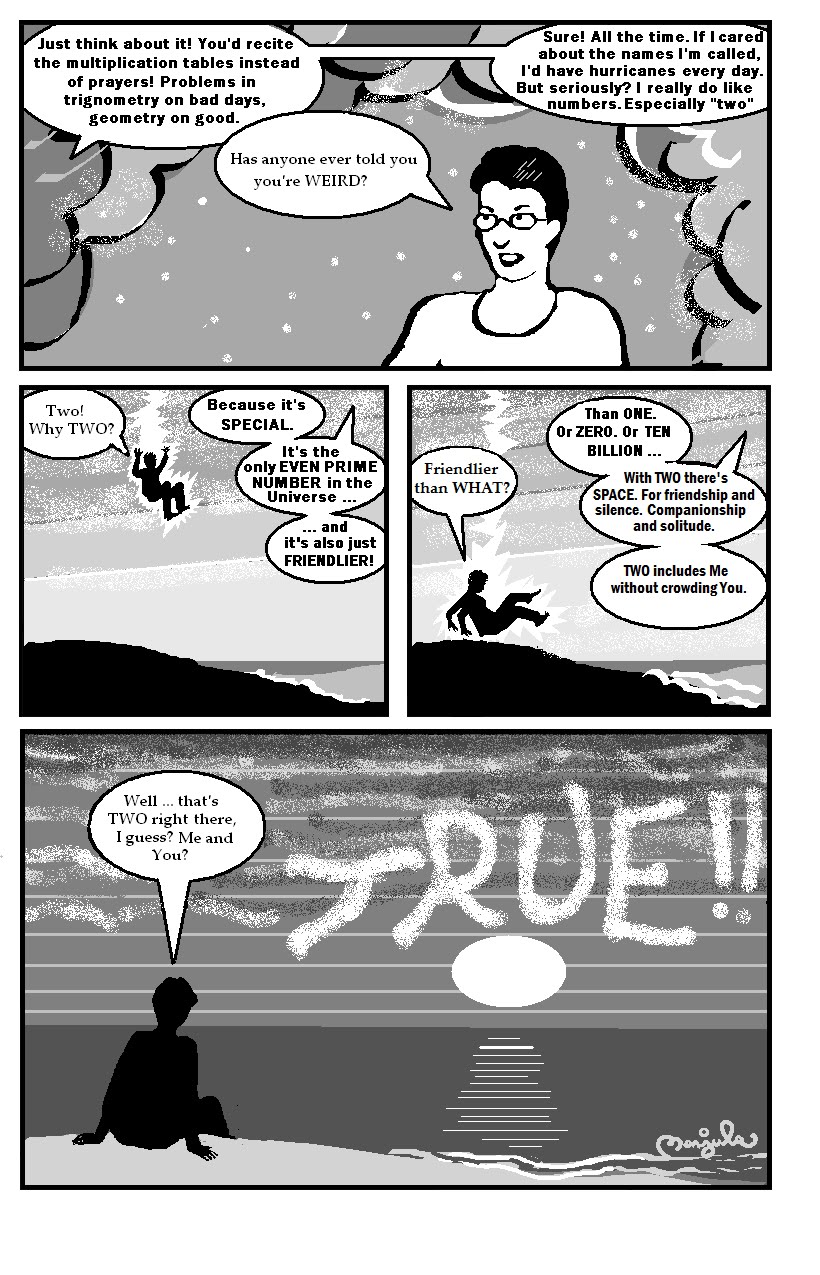
When VEENA SESHADRI, editor of CHICKEN SOUP FOR THE INDIAN SPIRITUAL SOUL (Westland, 2009), asked me to contribute to her book, I DID say that I was a rather unusual choice for inclusion. I am not exactly famed for spirituality, I said. But she was warmly insistent and ... anyway, the result is this tiny graphic story. I don't know why it's taken me so long to post it here. Sloth, most likely.


Friday, October 08, 2010
From the Suki Archive
 TheSCREAM
 FrogLove
Saturday, September 25, 2010
SLUMCAKE MILLIONAIRES
This is a comment piece that appeared in OUTLOOK Magazine about a bizarre birthday gift: a cake in the shape of a SLUM. There's more about it HERE, including a photograph of the cake, tweets generated by the birthday party and then tweets in defense of the cake from the host of the party. London's the GUARDIAN also weighed in with a comment piece by Pervez Sharma.
Here's my piece:
This week I heard that a well-known Mumbai actress received a birthday present from her husband, of a cake in the shape of a slum. That’s right, a slum. It is reported to have been created with shanties, pipes and a road sign with the celebrity’s age displayed as its “gali number”. The first reaction that went through my head when I heard this description was, “Imagine even pretending to eat clogged drains and sewage!”
But the more I thought about it, the more difficult it was to say exactly why I found the idea nauseating. For instance, would it have been okay if something bitter and hard to chew had been created rather than a sweet and creamy luxury item? Or is it mean-spirited to assume that a slum would NOT be delicious to bite into? And by the way, is it inherently distasteful to think of eating up whole neighbourhoods? Or is it only distasteful when the neighbourhoods are not well-maintained? I can remember, for instance, that for my sixth birthday the party theme was clowns, with a cake to match. At my 10th, I helped decorate a cake in the shape of a medieval castle, with ice-cream cone towers. Does this mean that my family was grotesquely insensitive about medieval royalty and circus entertainers? Or is it okay to eat delicacies fashioned into symbols associated with wealth and pleasure while confectionery in the shape of destitute neighbourhoods must be condemned? And is that because we believe the destitution is unacceptable or our willingness to admit it exists that must be avoided at celebrations?
The more I thought about the thing, the more questions my mind generated. For instance, would someone, child or adult, who asked for leper-shaped desserts be considered depraved? Or would we think they were socially mature and responsible? Then what about pornographic puddings—would they be considered inappropriate at a child’s party? And does the shape of a birthday cake raise awareness? Or breed insensitivity? Would it be acceptable if, when a cake were made for someone who didn’t live in a slum, the dwellers had been invited in to eat it? Or is it so obviously offensive to make a dessert out of the visible symbol of the nation’s social inequalities that there’s no level at which inclusion becomes possible?
Is there anything that the revellers could have done that would have made it less objectionable, such as providing clean drinking water to a slum for a month? Or would only a full year’s supply make it okay? And would that be considered a responsible approach to lavish celebration or would it be tokenism to assuage guilt? Would it show a greater sense of humour and/or irony if there had been candles in the shape of slum-dwellers? And if it turns out that the slum-dwellers had benefited in the manufacture of the cake would that have made it all right? Or would the shape of the cake be okay if it had been made in order to be raffled and the ticket money given to the homeless?
The husband of the 60-year-old birthday baby is reported to have accused cake-critics of being humourless. The couple is known for their support to worthy causes and in particular to pavement-dwellers. So perhaps they should have responded to the criticism by gifting the residents of the slum closest to their residence a cake of matching size, but made in the shape of their own apartment building. Or—here’s a radical idea—how about cakes in the shapes of politicians, made to be eaten by their opponents? Religious icons too! And would that result in cake-eating becoming a politically charged activity with opposing parties ostentatiously gobbling up the religious icons of their enemies? Might we be entering an era of cake-wars? And would anyone who pointed fingers at those who objected to such activities be told that they lacked a sense of humour?
In the end, there’s no way of policing or legislating such things. People of conscience must know in their hearts whether or not they’re using a symbol appropriately. If not, it really doesn’t matter whether they are leftists eating slum-shaped cakes or anti-abortionists eating foetus-shaped eclairs. The moral of the story is, you can’t have your ideology and eat it too.
Here's my piece:
This week I heard that a well-known Mumbai actress received a birthday present from her husband, of a cake in the shape of a slum. That’s right, a slum. It is reported to have been created with shanties, pipes and a road sign with the celebrity’s age displayed as its “gali number”. The first reaction that went through my head when I heard this description was, “Imagine even pretending to eat clogged drains and sewage!”
But the more I thought about it, the more difficult it was to say exactly why I found the idea nauseating. For instance, would it have been okay if something bitter and hard to chew had been created rather than a sweet and creamy luxury item? Or is it mean-spirited to assume that a slum would NOT be delicious to bite into? And by the way, is it inherently distasteful to think of eating up whole neighbourhoods? Or is it only distasteful when the neighbourhoods are not well-maintained? I can remember, for instance, that for my sixth birthday the party theme was clowns, with a cake to match. At my 10th, I helped decorate a cake in the shape of a medieval castle, with ice-cream cone towers. Does this mean that my family was grotesquely insensitive about medieval royalty and circus entertainers? Or is it okay to eat delicacies fashioned into symbols associated with wealth and pleasure while confectionery in the shape of destitute neighbourhoods must be condemned? And is that because we believe the destitution is unacceptable or our willingness to admit it exists that must be avoided at celebrations?
The more I thought about the thing, the more questions my mind generated. For instance, would someone, child or adult, who asked for leper-shaped desserts be considered depraved? Or would we think they were socially mature and responsible? Then what about pornographic puddings—would they be considered inappropriate at a child’s party? And does the shape of a birthday cake raise awareness? Or breed insensitivity? Would it be acceptable if, when a cake were made for someone who didn’t live in a slum, the dwellers had been invited in to eat it? Or is it so obviously offensive to make a dessert out of the visible symbol of the nation’s social inequalities that there’s no level at which inclusion becomes possible?
Is there anything that the revellers could have done that would have made it less objectionable, such as providing clean drinking water to a slum for a month? Or would only a full year’s supply make it okay? And would that be considered a responsible approach to lavish celebration or would it be tokenism to assuage guilt? Would it show a greater sense of humour and/or irony if there had been candles in the shape of slum-dwellers? And if it turns out that the slum-dwellers had benefited in the manufacture of the cake would that have made it all right? Or would the shape of the cake be okay if it had been made in order to be raffled and the ticket money given to the homeless?
The husband of the 60-year-old birthday baby is reported to have accused cake-critics of being humourless. The couple is known for their support to worthy causes and in particular to pavement-dwellers. So perhaps they should have responded to the criticism by gifting the residents of the slum closest to their residence a cake of matching size, but made in the shape of their own apartment building. Or—here’s a radical idea—how about cakes in the shapes of politicians, made to be eaten by their opponents? Religious icons too! And would that result in cake-eating becoming a politically charged activity with opposing parties ostentatiously gobbling up the religious icons of their enemies? Might we be entering an era of cake-wars? And would anyone who pointed fingers at those who objected to such activities be told that they lacked a sense of humour?
In the end, there’s no way of policing or legislating such things. People of conscience must know in their hearts whether or not they’re using a symbol appropriately. If not, it really doesn’t matter whether they are leftists eating slum-shaped cakes or anti-abortionists eating foetus-shaped eclairs. The moral of the story is, you can’t have your ideology and eat it too.
Review of HOWARD JACOBSON'S The Finkler Question
This review THE FINKLER QUESTION by Howard Johnson appeared in Times of India's CREST. It's a subscription site, so you'd have to log in to read it there. Anyway, here's the review (this is my version of the review. The print edition may differ in small ways -- the title for instance):
SORRY, PLEASE! I'M NOT JEWISH
There are some books that make me want to lie flat on the floor and howl. Not with fear or laughter, but the sheer tedium of having to plough through them. If this one hadn't been expressed in such elegant and well-turned language, it would have been easier to ignore. So alas, part of my complaint against the book is that its author Howard Jacobson writes so well that we can see the emptiness at the heart of his novel all the more precisely.
The story revolves around Julian Treslove. He is presented as the type of human being who should have been drowned at birth, like an unwanted kitten ¬– except of course that would only have lead to a novel being written in the voice of an exceptionally annoying phantom. We are told that Treslove has no qualities to recommend him: unreliable as a friend, disloyal as a lover, uncaring as a father as well as monumentally sentimental and romantic. The cherry – or do I mean the eye-ball dipped in red dye? – on top of this dismal list, however, is his obsessive fascination with Jewishness. He is the one who considers it an affliction, in part because he isn't a Jew, in part because he considers his entire existence to be an affliction. The question that gives the book its title is based on Treslove's use of the name "Finkler" as his personal code-word to mean "Jew". The novel's ultimate theme is about what it means to be Jewish in a post-Holocaustian world, where yesterday's victims are today's terrorists and tomorrow's front-page corpses might be yours, mine or the Palestinian family's next-door.
Treslove's two dearest friends are Jews. Samuel Finkler and Treslove were in school together while the nonagenarian Libor Sevcik was at one time a teacher to both boys. At the beginning of the book, Finkler and Libor have both lost their wives. Libor's marriage was long, loving and intensely loyal, Finkler's was shorter and riven with infidelities – marital, ideological, intellectual. It is through Libor that Treslove meets Hephzibah, the woman who most fulfils his notion of Ideal Life-Mate. But his relationship with her is so compromised by his self-image as a cultural chimaera, a gentile Jew, that he ceases to maintain his integrity as a convincing character. It's enough that the world has Israel, Palestine and Woody Allen's New York-style neuroses to contend with. The spectacle of a non-Jewish Englishman moaning about the angst of not having Jewishness to moan about is too absurd to be funny and not pathetic enough to be interesting.
Perhaps one of the reasons I found the novel merely self-indulgent rather than insightful or poignant is that I already know, as an Asian belonging to a post-colonial nation, a fair amount about the inclusion-exclusion game as it is played out in urban situations around the world. Through Treslove's character, Jacobson seems to want his readers to re-explore the notion that the Jewish version of this game is still the most riveting one around. But it no longer is for me or, at least, not in the hands of this writer. According to the back-cover blurb this is a "scorching story of exclusion and belonging, ageing, wisdom and humanity … funny, furious, unflinching …' And it's on this year's Man-Booker Prize shortlist. Brrrrr! The longlist must have been grim indeed.
SORRY, PLEASE! I'M NOT JEWISH
There are some books that make me want to lie flat on the floor and howl. Not with fear or laughter, but the sheer tedium of having to plough through them. If this one hadn't been expressed in such elegant and well-turned language, it would have been easier to ignore. So alas, part of my complaint against the book is that its author Howard Jacobson writes so well that we can see the emptiness at the heart of his novel all the more precisely.
The story revolves around Julian Treslove. He is presented as the type of human being who should have been drowned at birth, like an unwanted kitten ¬– except of course that would only have lead to a novel being written in the voice of an exceptionally annoying phantom. We are told that Treslove has no qualities to recommend him: unreliable as a friend, disloyal as a lover, uncaring as a father as well as monumentally sentimental and romantic. The cherry – or do I mean the eye-ball dipped in red dye? – on top of this dismal list, however, is his obsessive fascination with Jewishness. He is the one who considers it an affliction, in part because he isn't a Jew, in part because he considers his entire existence to be an affliction. The question that gives the book its title is based on Treslove's use of the name "Finkler" as his personal code-word to mean "Jew". The novel's ultimate theme is about what it means to be Jewish in a post-Holocaustian world, where yesterday's victims are today's terrorists and tomorrow's front-page corpses might be yours, mine or the Palestinian family's next-door.
Treslove's two dearest friends are Jews. Samuel Finkler and Treslove were in school together while the nonagenarian Libor Sevcik was at one time a teacher to both boys. At the beginning of the book, Finkler and Libor have both lost their wives. Libor's marriage was long, loving and intensely loyal, Finkler's was shorter and riven with infidelities – marital, ideological, intellectual. It is through Libor that Treslove meets Hephzibah, the woman who most fulfils his notion of Ideal Life-Mate. But his relationship with her is so compromised by his self-image as a cultural chimaera, a gentile Jew, that he ceases to maintain his integrity as a convincing character. It's enough that the world has Israel, Palestine and Woody Allen's New York-style neuroses to contend with. The spectacle of a non-Jewish Englishman moaning about the angst of not having Jewishness to moan about is too absurd to be funny and not pathetic enough to be interesting.
Perhaps one of the reasons I found the novel merely self-indulgent rather than insightful or poignant is that I already know, as an Asian belonging to a post-colonial nation, a fair amount about the inclusion-exclusion game as it is played out in urban situations around the world. Through Treslove's character, Jacobson seems to want his readers to re-explore the notion that the Jewish version of this game is still the most riveting one around. But it no longer is for me or, at least, not in the hands of this writer. According to the back-cover blurb this is a "scorching story of exclusion and belonging, ageing, wisdom and humanity … funny, furious, unflinching …' And it's on this year's Man-Booker Prize shortlist. Brrrrr! The longlist must have been grim indeed.
Sunday, September 12, 2010
HONEY DREAM
It's very unusual for me to express any thoughts in the form of a poem. But here's something that might be called a poem. It's an image-file, not a document (because I wanted a coloured background) so if the image looks like a miniature with ants crawling across it, click on it. That should cause it to pop up in a separate window and at full size.


Thursday, September 02, 2010
DELHIRIUM graphic!
This illustration was commissioned by OUTLOOK TRAVELLER to accompany an article by LUCY PECK about Delhi's monuments. I am usually disappointed when I see my work in print but I think this one looks rather sweet in the current issue -- I don't think the issue's been uploaded to the net yet but it's on the stands. The illustration looks a little different in print because I created it in two versions, stacked (as it appears here) and also as a border across two pages (as it appears in the magazine).
Ah -- and here's a link to the article itself, THE OLDER DELHIS.

Ah -- and here's a link to the article itself, THE OLDER DELHIS.

PAUL THEROUX's SIR VIDIA'S SHADOW
I've just finished reading Paul Theroux's SIR VIDIA'S SHADOW
and am still tingling with pleasure. I have always liked Theroux as a writer and look forward to his books but for some reason never got around to reading this one when it came out in 1998/99. Perhaps because I was not interested enough in VS Naipaul to care that they'd apparently had a falling out; perhaps because the reviews suggested that Theroux exposed himself as spiteful and small-minded while criticizing a famous lit-giant.
Whatever.
I am glad now that I waited to read it because in the intervening years I have read several new books by Theroux but only the odd word or two by Naipaul. The fact that the latter was finally awarded a Nobel changes nothing: I don't choose my reading based on prizes. I read 'SHADOW as if it were a murder mystery -- but with a friendship rather than a corpse at the heart of the mystery.
I would say that it's a must-read for anyone who is interested in books and literature, in writers and their lives. Theroux does expose himself -- and that is what makes this such an unusual book -- it's like reading the diary of an intelligent, well-read and sophisticated lover who has been jilted in the most atrocious way and then, in the way of ALL lovers, intelligent or not, cannot stop himself from screaming his heart out. The entire book is a very well-articulated, superbly crafted scream of deep, unquenchable heart-hurt. The pain of a lost friendship IS often more unbearable than the loss of romantic/sexual/conjugal love because it very often involves betrayals at levels that the loser does not even know existed until they are revealed.
It is a wonderful book, better than any fiction. Go on, then: run out and buy it/borrow it/read it AT ONCE.
Sunday, August 29, 2010
CUTTING CIRCLES
If you've never felt the need to cut circles out of a sheet of paper, you should stop reading this blog-post right now. If, however, you have spent the greater part of your life wondering if -- uh, no: feeling CERTAIN that -- somewhere in the Universe there's a gadget that cuts circles out of an ordinary sheet paper easily and without mess, then what I'm about to describe may be of use to you.
Perhaps it's something that graphic designers and artists are taught on their first day at art school -- but I didn't go to art school and also I didn't hang out with the kinds of people who ever showed the slightest interest in cutting circles out of paper, so I missed out on this little trick and had to wait 57 years to wake up one day and work it out for myself.
You'll need a couple of pieces of equipment: one, a compass with a bow-attachment and two, a box-cutter or Exacto knife. And of course a sheet of paper, a drawing board and a cup of water.
A bow attachment is something that is bundled along with most good compass sets and is used for drawing circles in ink rather than with a pencil-point. It resembles the beak of a slightly peevish hornbill -- and is definitely an instrument that looks as if it was designed in the nineteenth century (and probably was). But the point is, it works rather well, so long as one is reasonably un-clumsy with open bottles of ink.
Anyway. For the purpose of cutting circles out of paper, you don't use ink with your bow attachment. Instead, you fit the attachment to the arm of the compass that usually holds a pencil point and you dip the beak of the bow in the cup of water. This causes a very small amount of water to be taken up at the tip of the bow. Then you use the compass in the usual way, depositing a circle in plain water onto your sheet of paper. Put the compass down, wipe the tip of the bow (so that it doesn't rust) and then, using the box-cutter and/or Exacto knife, gently separate the circle from the rest of the sheet -- the water will weaken the paper just enough to allow you to do this without ripping the paper sideways. Ta-daaaaa! A neat and graceful circle-shaped aperture appears where before there was none.
It works best with thin paper of course -- but I cut a large number of circles out 150 gsm card the other day, slicing along the water track left by the bow attachment, with very little difficulty. The results were definitely neater and more circular than if I'd just used the cutter on its own.
All through my life, I have tried cutting circles out using scissors (hopeless!) and tiny knife-blades with circle-templates but the results have not been good because (a) tiny knife-blades seem to get blunt very easily so they require a great deal of pressure and (b) when the blades are NOT blunt, they slice through the plastic of the template. I have also tried attaching blades of various kinds to my compasses but it is too much of a struggle, and anyway, the blades bend and wiggle in a most uncooperative manner. Google searches reveal that Rotring and Staedtler make blade attachments for compasses -- but then these are NOT standard add-ons with compass sets and I have never got around to buying one.
No doubt there are laser-cutters out there, made exclusively for the professional and non-garden-variety of circle-cutter. But for me, this late-life discovery of the uses of a bow-attachment is very pleasant and I am very grateful to the Muse of Circles, whoever she is, for whispering this secret in my ear.
Monday, August 23, 2010
POPCORN MAGNOLIANA
This is an idea I had this morning for what will undoubtedly become a major snack item. My suggested name is:
POPCORN MAGNOLIA
The main (only!) ingredient is POPCORN.
Using freshly popped corn, squeeze the popped kernels into small molds about the size of fish fingers, plus something to keep the forms from breaking apart, like some kind of light batter (but not enough to seriously flavour the corn). Then these can be arranged on a plate around different kinds of dips -- such as hot caramel sauce, or chocolate for a sweet and sticky snack -- and Mughlai gravy, or BBQ sauce for savoury treats!
------------------------------
POPCORN MAGNOLIA
The main (only!) ingredient is POPCORN.
Using freshly popped corn, squeeze the popped kernels into small molds about the size of fish fingers, plus something to keep the forms from breaking apart, like some kind of light batter (but not enough to seriously flavour the corn). Then these can be arranged on a plate around different kinds of dips -- such as hot caramel sauce, or chocolate for a sweet and sticky snack -- and Mughlai gravy, or BBQ sauce for savoury treats!
------------------------------
Many people make popcorn "balls" using honey or golden syrup to bind em up -- but there's no reason that something else can't be used -- I mean something savoury -- and at the same time, it's okay in my book to dip something with a sweet under-carriage into a savoury sauce.
Friday, August 20, 2010
A MONKEY-PUZZLE STORY
REVIEW: MONKEY MAN by Usha K.R.
[This has appeared in the current issue of BIBLIO]
Like an experienced angler landing a difficult catch, Usha KR keeps her line taut all the way through this elegantly plotted novel. Not till the end do we get to see the whole thing as it lies panting and struggling, revealed at last in all its oddity, neither a mystery nor a romance but a story of people caught in the embrace of a complex and hairy otherness.
[This has appeared in the current issue of BIBLIO]
Like an experienced angler landing a difficult catch, Usha KR keeps her line taut all the way through this elegantly plotted novel. Not till the end do we get to see the whole thing as it lies panting and struggling, revealed at last in all its oddity, neither a mystery nor a romance but a story of people caught in the embrace of a complex and hairy otherness.
The tale begins in Bangalore, as a fictional account of the real-life events that took place in New Delhi, circa May 2001. Reports began circulating of a mysterious, humanoid creature that attacked innocent citizens during the hours of darkness, causing a fear-psychosis to grip the city. The panic lasted for perhaps six months, resulting in injuries ranging from deep scratches to severe trauma and even death: at least two people were reported to have died as a result of falling down a flight of stairs while trying to escape from the monster. But the creature, such as it was, was never caught either in person or on film. The police released sketches based on eye-wtiness accounts, but ultimately, according to Wikipedia, "the entire incident has been described as an example of mass hysteria".
Usha's retelling of this half-forgotten news story is set in January 2000. A teacher called Shrinivas Moorty forms the heart of the book. Despite a sterile marriage and dead-end career, he has entered his middle-years with a few shreds of his youthful dreams still clinging to him. Next is Neela Mary Gopalrao, the woman bureaucrat at the Centre for Socio-Economic Studies who rules over her private fiefdom of clerks and peons with a rod of petty cruelties: cheques that will be needlessly delayed, inter-departmental letters that will never be delivered, cutting remarks that can never be countered for fear of dismissal. Finally there is Pushpa Rani, the young woman who has powered her way out of the slums and into a call-centre with the tenacity of a peepul-tree seedling growing out of a brick wall.
We are told at the outset that these three lives will be braided together and held in place by that monkey-shaped filament whose name adorns the cover of the book. And we look for the creature, as we enter the opening chapters, wondering from which corner of Ammanaguddi Street, dug up and traffic-clogged as it is, the shadowy being will spring. But the lives of the three characters soon dominate the stage and we are diverted by the unspooling of their histories until suddenly, with a twitch and a stifled scream, yes – there's the creature! Or … wait: what exactly are we looking for, again? Is this a novel about three fictional characters or a documentary about the changing soul of Bangalore? About a city or a country? About you or I? By the time we end the book, we know a little more about what we might have believed when we began it, but we also look reflexively over our own shoulders, wondering about the monkey-shaped spectres that haunt the hidden corridors of all our lives.
Usha K.R.'s gift as a writer is her ability to convince us that even the slighteset of stories is worth caring about. Her characters are so unremarkable that if not for the precision with which she describes them, we would not pay them a second's attention. Moorty, for instance: he has a slight paunch, his hair is thinning, he rides a scooter. Even the elements that make up his tiny inner spark, the love of western rock music, the fondness for good cinema and the Nehruvian socialism that still animates his deepest memories, are hardly very original. The songs and the bands are only too familiar, the socialism has grown so stale and the movies are all a bit passé now. But it is this very ordinariness that makes the portrait so convincing. Like a frog that has been expertly dissected for us by our biology teacher, the fact that it is commonplace is precisely why we value it – because it reveals what is commonplace about all frogs.
Pushpa Rani by contrast, is a character whose real-life counterparts are so recently evolved from the primordial slime of India's social inequalities that her feet as still a little webbed, a little unknowable. None of us has enough data about what lies in the future of all the Pushpa Ranis rising up from the slums and shanty towns of Indian cities and in that sense a literary character created from her clay can be molded to fit almost any role. Neela is more familiar, the petty bureaucrat in the starched cotton sari, but she has some unexpected flourishes too. She is of mixed Hindu-Christian parentage and for that reason is neither wholly respectable nor wholly pariah. She is that stock figure-of-fun, a card-carrying member of the Spinster Party who will nevertheless permit one single pulse-beat of indiscretion to rattle around her veins for the rest of her natural life.
The secondary characters are as well-realized as the principals. They include Neela's underlings such as the brash, good-hearted peon Sukhiya Ram and her single overlord in the official pantheon, the lofty Dr Subramanyam; 'Bali Brums', short for Balaji Brahmendra, the "charismatic and hugely popular radio jockey of the city's brand new and only FM channel, Voices from Heaven"; and Moorty's fragile wife Lily, with her beauty and her childlessness, and Moorty's colleague at work Jairam, with his America-returned born-again capitalism. Pushpa Rani's co-workers and family have a faintly filmi quality to them, as if we have either seen them in BBC documentaries about Call Centres or in commercials about the near-magical properties of skin-fairness creams.
Holding all the characters together is the personality of the street along which so much of the action takes place. "The Ammanagudi Street of [Moorty's] boyhood was a nice mix of cows and men, and of course, the goddess after whom the street was named. Of the old shops, only two remained – a cycle-repair shop and a flour mill, going about their business for more than thirty years – before they were shown up by a fast food "palace" selling hot tomato soup at five rupees per cup and a cyber café with twenty-four-hour Internet access … now that he had to go past the temple every day for the past two years, past the potholes filled with the over-runs from the manholes and the plastic bags that floated on the scum and got caught in the foot rests of his scooter every now and then, he had seen for himself how the Mother lived and even become familiar with Her routine. Every morning he did what every other passerby did – turn right to have a glimpse of her face – black stone, freshly annointed with oil, her nose, eyes and mouth outlined in silver, calmy accepting of all that her devotees did to her. A trishula was planted in front of her, lemons impaled fresh every morning on each of the three prongs – marking the bounds of direct access. No one could venture beyond except her priest – an unsmiling young man with a crew cut, the razor-trimmed arc of hair clean and precise against the skin of his neck. Late one morning Shrinivas Moorty had been witness to the priest lighting up a beedi and having a quiet smoke after closing the temple, and then making his way to the self-service joint up Ammanagudi street, presumbaly for an idli-vada … [The Mother] reminded him of his wife – the same mysterious rituals with the unguents and the stoic acceptance of worship. He remembered his mother and sister, who were easier than Lily and the Mother, and whose ablutions too were not as complicated, rubbing on their faces something called Afghan Snow, that came in an icy white glass jar and had a picture melting snow-covered peaks on the outside." (pgs 13 & 17)
Just as the street succumbs to the indignities of being dug up and built over, slowly strangulated with underground cables and wholly choked with a combination of garbage and over-sized cars, so too the human inhabitants succumb to the changes that have stampeded over them. In this twilight of the senses, where all that was once so familiar has been replaced by cement and plastic, the emergence of a "half-man half-beast" that briefly held several Indian cities in the grip of a fear psychosis is perhaps not surprising. As an interesting speculation about a phenomenon that was never properly explained the novel is refreshing and provocative. I look forward to whatever next Usha KR has in store for her readers.
Usha's retelling of this half-forgotten news story is set in January 2000. A teacher called Shrinivas Moorty forms the heart of the book. Despite a sterile marriage and dead-end career, he has entered his middle-years with a few shreds of his youthful dreams still clinging to him. Next is Neela Mary Gopalrao, the woman bureaucrat at the Centre for Socio-Economic Studies who rules over her private fiefdom of clerks and peons with a rod of petty cruelties: cheques that will be needlessly delayed, inter-departmental letters that will never be delivered, cutting remarks that can never be countered for fear of dismissal. Finally there is Pushpa Rani, the young woman who has powered her way out of the slums and into a call-centre with the tenacity of a peepul-tree seedling growing out of a brick wall.
We are told at the outset that these three lives will be braided together and held in place by that monkey-shaped filament whose name adorns the cover of the book. And we look for the creature, as we enter the opening chapters, wondering from which corner of Ammanaguddi Street, dug up and traffic-clogged as it is, the shadowy being will spring. But the lives of the three characters soon dominate the stage and we are diverted by the unspooling of their histories until suddenly, with a twitch and a stifled scream, yes – there's the creature! Or … wait: what exactly are we looking for, again? Is this a novel about three fictional characters or a documentary about the changing soul of Bangalore? About a city or a country? About you or I? By the time we end the book, we know a little more about what we might have believed when we began it, but we also look reflexively over our own shoulders, wondering about the monkey-shaped spectres that haunt the hidden corridors of all our lives.
Usha K.R.'s gift as a writer is her ability to convince us that even the slighteset of stories is worth caring about. Her characters are so unremarkable that if not for the precision with which she describes them, we would not pay them a second's attention. Moorty, for instance: he has a slight paunch, his hair is thinning, he rides a scooter. Even the elements that make up his tiny inner spark, the love of western rock music, the fondness for good cinema and the Nehruvian socialism that still animates his deepest memories, are hardly very original. The songs and the bands are only too familiar, the socialism has grown so stale and the movies are all a bit passé now. But it is this very ordinariness that makes the portrait so convincing. Like a frog that has been expertly dissected for us by our biology teacher, the fact that it is commonplace is precisely why we value it – because it reveals what is commonplace about all frogs.
Pushpa Rani by contrast, is a character whose real-life counterparts are so recently evolved from the primordial slime of India's social inequalities that her feet as still a little webbed, a little unknowable. None of us has enough data about what lies in the future of all the Pushpa Ranis rising up from the slums and shanty towns of Indian cities and in that sense a literary character created from her clay can be molded to fit almost any role. Neela is more familiar, the petty bureaucrat in the starched cotton sari, but she has some unexpected flourishes too. She is of mixed Hindu-Christian parentage and for that reason is neither wholly respectable nor wholly pariah. She is that stock figure-of-fun, a card-carrying member of the Spinster Party who will nevertheless permit one single pulse-beat of indiscretion to rattle around her veins for the rest of her natural life.
The secondary characters are as well-realized as the principals. They include Neela's underlings such as the brash, good-hearted peon Sukhiya Ram and her single overlord in the official pantheon, the lofty Dr Subramanyam; 'Bali Brums', short for Balaji Brahmendra, the "charismatic and hugely popular radio jockey of the city's brand new and only FM channel, Voices from Heaven"; and Moorty's fragile wife Lily, with her beauty and her childlessness, and Moorty's colleague at work Jairam, with his America-returned born-again capitalism. Pushpa Rani's co-workers and family have a faintly filmi quality to them, as if we have either seen them in BBC documentaries about Call Centres or in commercials about the near-magical properties of skin-fairness creams.
Holding all the characters together is the personality of the street along which so much of the action takes place. "The Ammanagudi Street of [Moorty's] boyhood was a nice mix of cows and men, and of course, the goddess after whom the street was named. Of the old shops, only two remained – a cycle-repair shop and a flour mill, going about their business for more than thirty years – before they were shown up by a fast food "palace" selling hot tomato soup at five rupees per cup and a cyber café with twenty-four-hour Internet access … now that he had to go past the temple every day for the past two years, past the potholes filled with the over-runs from the manholes and the plastic bags that floated on the scum and got caught in the foot rests of his scooter every now and then, he had seen for himself how the Mother lived and even become familiar with Her routine. Every morning he did what every other passerby did – turn right to have a glimpse of her face – black stone, freshly annointed with oil, her nose, eyes and mouth outlined in silver, calmy accepting of all that her devotees did to her. A trishula was planted in front of her, lemons impaled fresh every morning on each of the three prongs – marking the bounds of direct access. No one could venture beyond except her priest – an unsmiling young man with a crew cut, the razor-trimmed arc of hair clean and precise against the skin of his neck. Late one morning Shrinivas Moorty had been witness to the priest lighting up a beedi and having a quiet smoke after closing the temple, and then making his way to the self-service joint up Ammanagudi street, presumbaly for an idli-vada … [The Mother] reminded him of his wife – the same mysterious rituals with the unguents and the stoic acceptance of worship. He remembered his mother and sister, who were easier than Lily and the Mother, and whose ablutions too were not as complicated, rubbing on their faces something called Afghan Snow, that came in an icy white glass jar and had a picture melting snow-covered peaks on the outside." (pgs 13 & 17)
Just as the street succumbs to the indignities of being dug up and built over, slowly strangulated with underground cables and wholly choked with a combination of garbage and over-sized cars, so too the human inhabitants succumb to the changes that have stampeded over them. In this twilight of the senses, where all that was once so familiar has been replaced by cement and plastic, the emergence of a "half-man half-beast" that briefly held several Indian cities in the grip of a fear psychosis is perhaps not surprising. As an interesting speculation about a phenomenon that was never properly explained the novel is refreshing and provocative. I look forward to whatever next Usha KR has in store for her readers.
ADDITIONALLY ...
Here's a link to a feature article that appeared in last week's issue of OUTLOOK (i.e., the Aug 15th issue for this year) about FOUR FAMILIES -- North, South, East, West -- each one having travelled a great distance from its origins. Inspirational.
Saturday, August 07, 2010
Catching Up
 Waffle
 ShowerBath
 BeerWagon
 Divya,Deke,Boston
The past few weeks have passed in a blur of activity. I'm not even going to try to present a clear record of all that happened. But these pictures may provide a few clues -- starting with the ENORMOUS Belgian waffle at the very top and ending with the wedding photograph of my niece Divya and nephew-in-law Deke at the event in Boston, 17th July.
The three days in Belgium were pure pleasure, spent in the company of Paul and Bea, exceptional hosts. The two pictures following the waffle are both from Belgium. One is of the shower-cum-sunken bath of the Ah-MAAAAZING hotel at which P&B accommodated me as their guest -- it was a small manor which had been renovated maintaining its authentic turn-of-the-century opulence, complete with constantly playing classical music in the foyer and courtesy wine in the little garden at the back. The second is of a beer-fuelled wagon -- the seated beer-drinkers cycle in unison, which is what powers the small wagon they're sitting in!
We did a lightning tour of Ghent and Bruges with a brief follow-through in Brussels including a visit to the newly opened RENE MAGRITTEmuseum, on the day before my departure, on Sunday 11th.
I arrived in NYC on the 12th, discovered to my great delight that there's a shuttle bus service direct from the airport to Port Authority Bus Station -- it's called NYAS, stands forNew York Airport Service and is REALLY convenient. At Port Authority I got onto the bus to Binghamton, arrived on schedule at 6 pm and there was my sister Su waiting to collect me and drive us both back to Sayre.
I was two nights in Sayre, then Su and I left for Boston, by car, on Wednesday. We checked into the Marriott in the evening, and on Thursday guests began to arrive for the wedding. Paul and Bea flew in from Belgium and I went to the airport to meet them, while Su and Divya came by in their car to collect all three of us and return us to the hotel. In between, I also had a most enjoyable lunch and business meeting with the publishers of the American edtion of I AM DIFFERENT, in Boston, that same afternoon.
Friday was spent with P&B, doing a "DUCK TOUR" of Boston and generally having a good time. The first formal wedding event took place at the hotel in the afternoon -- a mehendi ceremony plus cocktail and dinner -- it turned into an extremely lively affair as Deke's large family had begun to arrive and everyone was in Party Mode!
On Saturday, the wedding was scheduled at 4 pm, began on time and continued with dinner and dancing late into the night -- but not the wee hours. By the time we wrapped it, it was only 11.30 at night and we had cleared all our stuff out of the venue, which was Deke's Golf Club ball room. The next day, Sunday, was a general wrap up for all the guests at the hotel, since many of them left that day. Everyone was very relaxed, there was an enormous breakfast buffet, also attended by Deke and Divya. On Monday, Su and I drove back to Sayre.
I spent another three nights with her, then took the bus to New York on Friday. Spent a night with Visa & Chandru, then on Saturday left for Vermont, by train. It was a very pleasant ride -- I LOVE trains -- arriving exactly on time at 8.03 pm. Suzanna was there to collect me and in another hour we were in East Hardwick.
So THAT was great -- a huge change of pace -- there were three hives of bees, new goat babies (yes, I KNOW I can call them kids ...), turkey chicks in one enclosure, ordinary chicks in another enclosure, a steer whose head was soon to be on the chopping block, the haying was in full swing ... and much, much more. Including of course the mandatory fantastic meal at RAINBOW SWEETS of Marshfield, VT.
My final five days were especially hectic: by bus to White River Junction where I was met by Daisy, my friend in Lebanon (NH), and was whisked off to a lunch date with her new friend David, owner of the amazing MAIN STREET MUSEUM -- a museum of droll and unusual objects, chosen for "the stories" that are attached to them. The next day, Friday, I left for Newport via Boston's South Station, on the Dartmouth Coach.
I mention this because I managed to drop my little waist-pouch on the bus while getting off. Yes, OF COURSE my passport was in it! By the time I realized it was gone, so was the bus. But I was VERY lucky: the bus does an airport loop and returns to South Station. Meanwhile I had the help and reassurance of a very kind South Station control-booth officer called Keith, who called the driver of the Dartmouth Coach and confirmed that he had indeed discovered the pouch. An hour later, it was back in my hands, contents intact. PHEW. Only another Indian citizen will know what kind of nightmare it would be to lose travel documents just prior to an international flight.
ANYWAY. So I went on to Newport, spent two very happy nights with Steve, Marion and the girls, then returned to Lebanon for two very pleasant nights. On Tuesday morning at 6.15 a.m. Aaron, Daisy's husband, very kindly dropped me off at the bus terminal, where I boarded a nonstop coach all the way to New York. It stops very close to Grand Central Station, but I was able to catch the same convenient NYAS shuttle service back to JFK. My flight left on schedule at 6 pm. arrived an hour early in Brussels at 7 a.m., left again for Delhi and 10 a.m. and we landed once more at exactly 9.40 pm.
And that's my story for the past few weeks!
Monday, July 12, 2010
IN TRANSIT
... in Brussels airport. I've been off the net for three days and very BIZZY, staying with wonderfully hospitable friends in Ghent, Paul & Bea. Am now at the airport and getting ready to leave for NYC. I hope to post pictures and more news after I arrive. For now, I need to log off and concentrate on the flight ahead. I belong to a little-known sect of international travelers which believes that no flight we take can land or take off safely unless we guide it with the energy of our superior worrying ...
Sunday, July 04, 2010
JOEL STEIN in TIME Magazine, about those Immigration Blues
When I started reading MY OWN PRIVATE INDIA I assumed it was meant to be ironic. Then I began to think, well, you know? It's a view I vaguely sympathize with, because it IS unpleasant to wake up one day to find that one's familiar neighbourhood has become UNfamiliar. Everyone knows that. It's like falling asleep in a pale blue room and waking up in a green neon pizza parlour (or the reverse!).
Then I began to think, Uh-oh! Joel Stein's e-mail box is going to be filled with hot, wet hate VERY SOON!
MEANWHILE, in other news, here's my review of VISHWAJYOTI GHOSH's DELHI CALM. I can never find India Today's online review links, so this is my own text-version (with my title for it -- the print title is most likely different):
IN SEPIA VERITAS
The thing about a graphic novel is that it is so very personal. The author's hands have touched the work, not merely via the keyboard, but physically: the paper, the colours, the visual shape of the narrative. In this sense, it seems to me, Vishwajyoti Ghosh's graphic novel, his first solo work as an illustrator/artist, is so intensely internal that reading it is to trespass within the author's inner studio of thoughts, moods and memories. Even though he's invited us in by publishing the book, his style is that of an artist who would much rather not exhibit at all.
So yes: this is not a novel in the normal sense. Nor is it an autobiography. It's more like the disinterred remains of a national trauma, reconstructed by someone who must have been a small child at the time (three years old: I checked). The trauma was and is forever, the Emergency. Yet in this version, it is less a historical event than a state of mind. The political figures of that era are not named, nor are their parties vilified. The entire situation is presented as a crisis that began for an obscure reason and was then maintained forever, a bogeyman in the collective national psyche. The book suggests that as a nation and as a people, we have become so inured to being in condition of stressful anxiety that we have forgotten what it means to be any other way.
The narrative is presented in a series of discontinuous episodes focusing on the persona of a journalist, Vibhuti Prasad. Interspersed between his interactions with friends and fellow-thinkers, are sections presented in the form of newspaper clippings in which we see a character known as Moon who is clearly meant to represent a certain woman prime minister. The atmosphere of unease within the book is infectious to the extent that I find myself unwilling to name this historical character in my review. Indeed, it strikes me as both very odd and very sad that while India prides itself on being a nation with a free press, Ghosh could not afford to name anyone in his book.
The entire story is told as if it were a fever-dream, and though some events are all too familiar – the rise of the younger son, called Prince in this version, the forced sterilizations of that era, the midnight disappearances alongside the flowering of a rare and sweet idealism, as if only the extremes of political excess can squeeze the purest type of radicalism out of an otherwise inert populace – other effects are presented as fantasy. The wearing of ever-smiling masks, for instance, and the chopping back and forth across narrative lines.
The drawings are presented in a yellowy sepia brown, watercolour washes combined with sharp, scratchy ink-effects. I found the work most effective in some of the long perspectives, where the city is represented as a jumble of rickety aparments held together by telephone wires, illegal power cables and the once-ubiquitous cable TV lines. The title is a slap of bitter irony: there is nothing in the least bit calm about the book. It rakes over the coals of the past with anger and in mourning, for all that was lost and all that will never be.
Then I began to think, Uh-oh! Joel Stein's e-mail box is going to be filled with hot, wet hate VERY SOON!
MEANWHILE, in other news, here's my review of VISHWAJYOTI GHOSH's DELHI CALM. I can never find India Today's online review links, so this is my own text-version (with my title for it -- the print title is most likely different):
IN SEPIA VERITAS
The thing about a graphic novel is that it is so very personal. The author's hands have touched the work, not merely via the keyboard, but physically: the paper, the colours, the visual shape of the narrative. In this sense, it seems to me, Vishwajyoti Ghosh's graphic novel, his first solo work as an illustrator/artist, is so intensely internal that reading it is to trespass within the author's inner studio of thoughts, moods and memories. Even though he's invited us in by publishing the book, his style is that of an artist who would much rather not exhibit at all.
So yes: this is not a novel in the normal sense. Nor is it an autobiography. It's more like the disinterred remains of a national trauma, reconstructed by someone who must have been a small child at the time (three years old: I checked). The trauma was and is forever, the Emergency. Yet in this version, it is less a historical event than a state of mind. The political figures of that era are not named, nor are their parties vilified. The entire situation is presented as a crisis that began for an obscure reason and was then maintained forever, a bogeyman in the collective national psyche. The book suggests that as a nation and as a people, we have become so inured to being in condition of stressful anxiety that we have forgotten what it means to be any other way.
The narrative is presented in a series of discontinuous episodes focusing on the persona of a journalist, Vibhuti Prasad. Interspersed between his interactions with friends and fellow-thinkers, are sections presented in the form of newspaper clippings in which we see a character known as Moon who is clearly meant to represent a certain woman prime minister. The atmosphere of unease within the book is infectious to the extent that I find myself unwilling to name this historical character in my review. Indeed, it strikes me as both very odd and very sad that while India prides itself on being a nation with a free press, Ghosh could not afford to name anyone in his book.
The entire story is told as if it were a fever-dream, and though some events are all too familiar – the rise of the younger son, called Prince in this version, the forced sterilizations of that era, the midnight disappearances alongside the flowering of a rare and sweet idealism, as if only the extremes of political excess can squeeze the purest type of radicalism out of an otherwise inert populace – other effects are presented as fantasy. The wearing of ever-smiling masks, for instance, and the chopping back and forth across narrative lines.
The drawings are presented in a yellowy sepia brown, watercolour washes combined with sharp, scratchy ink-effects. I found the work most effective in some of the long perspectives, where the city is represented as a jumble of rickety aparments held together by telephone wires, illegal power cables and the once-ubiquitous cable TV lines. The title is a slap of bitter irony: there is nothing in the least bit calm about the book. It rakes over the coals of the past with anger and in mourning, for all that was lost and all that will never be.
Thursday, July 01, 2010
Review: SEASONS OF FLIGHT
This is the link to my review of Manjushree Thapa's Seasons of Flight. Here's the review:
In the opening pages, Prema, a young Nepali living in the US, is asked where she’s from. She tries explaining: “‘It is near India’, or ‘Where Mt Everest is’, or ‘You’ve heard of the Sherpas?’, so that they might say, ‘Geez, that’s real far’, or ‘I could have sworn you were Mexican/ Italian/Spanish’, or ‘You speak good English.’” In this efficient, endearingly familiar way, second-time novelist Manjushree Thapa introduces us to a story about displacement, self-definition and one South Asian woman’s search for fulfilment.
Prema’s story starts in a small village near Kathmandu, ascending quickly through the loss of her mother in childhood and the commonplace hardships of poverty, to a college degree in forestry, resulting in a job with an NGO. Secondary plot-lines include a younger sister who runs off with Maoist rebels when they come calling, an anaemic romance with a fellow NGO worker and a stoic, undemanding father who only wants to see her daughter go forward in her life.
One day, in a spirit of indifference, Prema signs up for the US Green Card Lottery. When she wins, her response is characteristically laconic, as if resigned to her fate. Her inner world, however, is taut with emotion and she turns her face westward with a faint quickening of hope. When she finds a lover in the US, an attractive Guatemalan, she responds with an ardour native to her own passionate nature and her mountain culture. Another kind of heroine might have capitalised on the romance to build the familiar multi-storeyed, bathos-laden Asian drama. Prema’s different. She knows her path is an “ever-directionless zigzag trail”. In the spirit of a true seeker, she exceeds the stereotype. Her strength lies in the miniature scale of her aspirations. Like a tiny field-mouse setting out to find a niche in the limitless sprawl of the North American cornfield, she succeeds by being undeterred by her smallness.
Thapa has a light touch and maintains an admirable balance between telling a story and making socio-cultural observations. I enjoyed noticing the altered perspective of someone who might be mistaken for an Indian, but isn’t. Prema’s personal life is enviably free of the guilt and family-honour-type tensions of the subcontinent. Thapa writes as if she knows what there is to enjoy about sex. In a literary ethos where authors all but compete to earn the Bad Sex award, it was a rare pleasure to read a description worthy of the opposite.
In the opening pages, Prema, a young Nepali living in the US, is asked where she’s from. She tries explaining: “‘It is near India’, or ‘Where Mt Everest is’, or ‘You’ve heard of the Sherpas?’, so that they might say, ‘Geez, that’s real far’, or ‘I could have sworn you were Mexican/ Italian/Spanish’, or ‘You speak good English.’” In this efficient, endearingly familiar way, second-time novelist Manjushree Thapa introduces us to a story about displacement, self-definition and one South Asian woman’s search for fulfilment.
Prema’s story starts in a small village near Kathmandu, ascending quickly through the loss of her mother in childhood and the commonplace hardships of poverty, to a college degree in forestry, resulting in a job with an NGO. Secondary plot-lines include a younger sister who runs off with Maoist rebels when they come calling, an anaemic romance with a fellow NGO worker and a stoic, undemanding father who only wants to see her daughter go forward in her life.
One day, in a spirit of indifference, Prema signs up for the US Green Card Lottery. When she wins, her response is characteristically laconic, as if resigned to her fate. Her inner world, however, is taut with emotion and she turns her face westward with a faint quickening of hope. When she finds a lover in the US, an attractive Guatemalan, she responds with an ardour native to her own passionate nature and her mountain culture. Another kind of heroine might have capitalised on the romance to build the familiar multi-storeyed, bathos-laden Asian drama. Prema’s different. She knows her path is an “ever-directionless zigzag trail”. In the spirit of a true seeker, she exceeds the stereotype. Her strength lies in the miniature scale of her aspirations. Like a tiny field-mouse setting out to find a niche in the limitless sprawl of the North American cornfield, she succeeds by being undeterred by her smallness.
Thapa has a light touch and maintains an admirable balance between telling a story and making socio-cultural observations. I enjoyed noticing the altered perspective of someone who might be mistaken for an Indian, but isn’t. Prema’s personal life is enviably free of the guilt and family-honour-type tensions of the subcontinent. Thapa writes as if she knows what there is to enjoy about sex. In a literary ethos where authors all but compete to earn the Bad Sex award, it was a rare pleasure to read a description worthy of the opposite.
Monday, June 28, 2010
Sonic Plaything
Like someone said at the site from which I got this, "Time for a break". Go play on this charming little TONE MATRIX.
Subscribe to:
Posts (Atom)